

Winning the returns war on Amazon
If you’re a 1P brand (Vendor) on Amazon, Q4 is a double-edged sword. Yes, Black Week and the holiday season bring a huge sales spike. But they also bring something else: a tidal wave of returns and chargebacks that quietly eat your margin, damage your operational metrics, and can even drag down your brand’s visibility on Amazon. This post breaks down why returns have become a strategic KPI for 1P vendors – and what you can practically do right now to protect your profits and your brand image.
A new reality of Amazon returns
Returns are no longer a side effect of selling online – they’re a core part of the P&L.
Across ecommerce, the average return rate in 2024 was about 16.9% (Shopify).
And during the holiday season, that rate spikes even higher:
- retailers expect holiday returns to be roughly 17% above the annual average (National Retail Federation)
- holiday ecommerce return rates around 20%+ (National Retail Federation)
Amazon’s customer-first model amplifies that:
- Longer return windows (National Retail Federation)
- Prepaid labels and frictionless flows that make sending items back incredibly easy (Shopify)
- In some cases, Amazon’s “returnless refunds”, where the customer gets the money back and keeps the item – great for CX, brutal for margins (Shopify)
Amazon’s 1P Return Rate Program
For 1P vendors, the real game-changer is Amazon’s new 1P return rate program:
- Frequently returned items are automatically flagged
- Amazon can charge manufacturers for return costs and deduct shipping and handling fees
- The search algorithm increasingly rewards low return rates, making returns a ranking factor
Bottom line: Your return rate is now a performance KPI on Amazon, not just a cost line item.
Why returns hurt vendors twice
Margin & Chargebacks
A return isn’t just a refund. By the time a product is sold, shipped, returned, processed, and either resold or scrapped, brands can lose 30%+ of the order value—especially in fashion or electronics (Shopify).
For 1P vendors, add Vendor Central chargebacks to the mix:
- Poor forecasting or re-shipments trigger compliance penalties
- Every return reason (“too small”, “not as described”) should lead to content updates
If you’re not monitoring return rates and chargebacks by ASIN, Q4 can turn your year in a load of pain.
5 levers to reduce returns
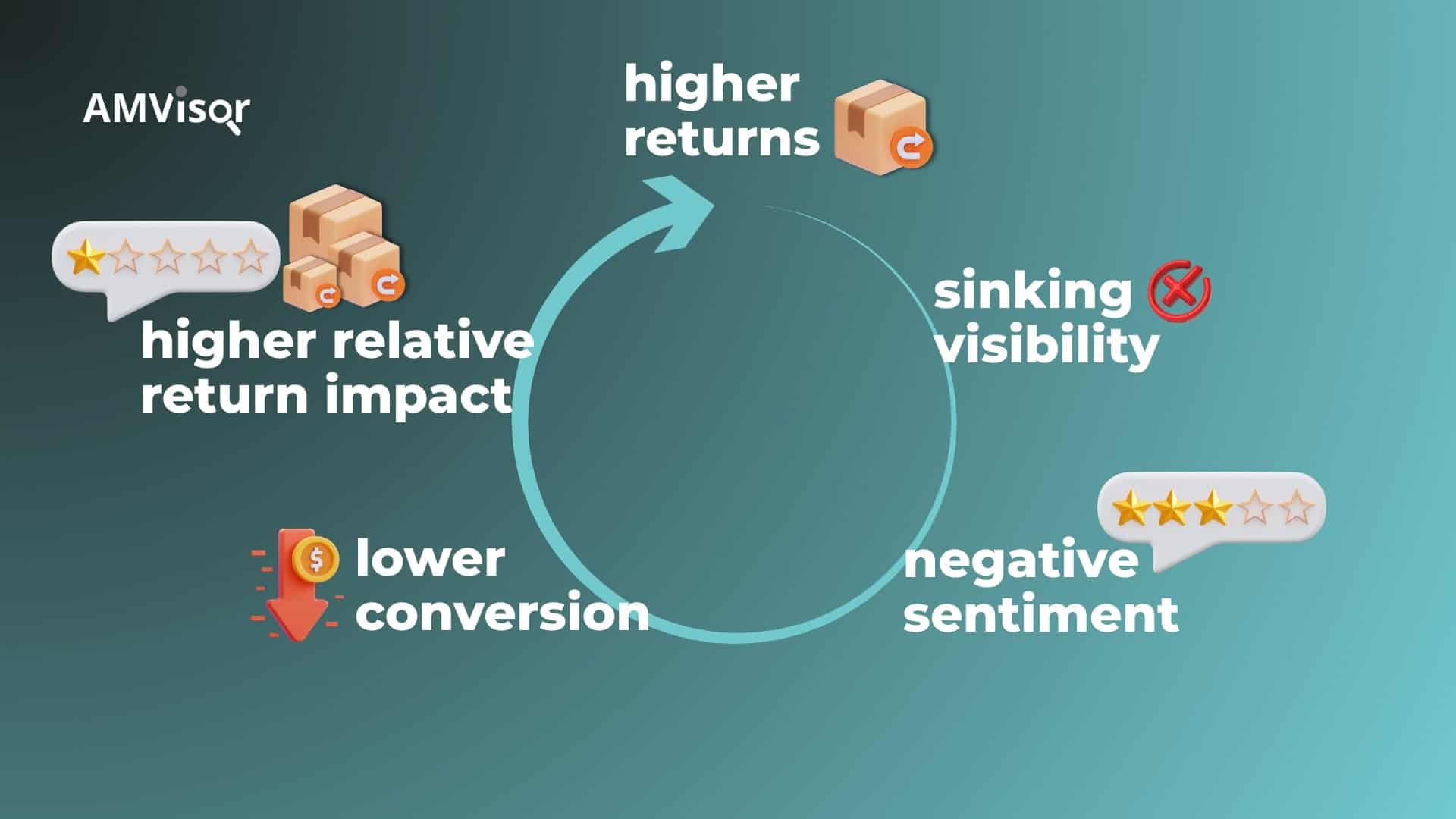
Returns are now a brand & ranking problem
High return rates affect:
- Search visibility (Amazon rewards low-return ASINs)
- Brand perception (negative reviews often mention returns)
- Buy-box performance
During Black Week and Christmas, this is dangerous: you might hit topline sales but damage ASIN health in the background.
Fix the expectation gap on product detail pages
Most avoidable returns come from misaligned expectations:
- Color slightly off
- Size doesn’t fit+
- Features misunderstood
Action Steps
- Brutally honest product copy
- Size & fit guides + “If you’re between sizes, choose X”
- Lifestyle imagery & video for real-world context
- “Best for / Not ideal for” bullets to pre-qualify buyers
Every return reason (“too small”, “not as described”) should translate into a specific content change on the detail page.
Use pre-purchase guidance to reduce “bracketing”
“Bracketing” – customers ordering multiple sizes or models with the intention of returning some – is a major driver of high holiday return rates.
Action steps
- Add size comparison tables (e.g. “Compared to Brand X, this fits slightly narrower/longer”)
- Use FAQ / Q&A sections to proactively answer common doubts
- Indicate who the product is ideal for (e.g. “best for narrow feet”, “ideal for small living rooms”, “suited for beginners rather than pros”)
- Where allowed, steer customers toward virtual try-on, fit finders, or configuration tools
The goal
Customers feel confident choosing one version – not three.
Treat reviews as free UX research
Every review that mentions a return is free product feedback.
Action steps
- Tag and categorize reviews that mention “returned” or “sent back”.
- Link them to the exact reason code from your returns data.
- Update product content, photos, and even packaging or instructions to address them.
Result
Fast responses to complaints (e.g. “We’ve updated our sizing chart based on your feedback”) don’t just help that one customer – they signal reliability to all future shoppers.
Steer demand toward low-returning ASINs
Not all SKUs are equal.
Action steps
- Push low-return ASINs via ads, coupons, bundles
- Make them heroes in Black Week campaigns
- Adjust pricing: aggressive on low-return SKUs, conservative on high-risk ones
How to cut the costs of returns
Reducing volume is one side; reducing cost per return is the other.
Action steps
- Monitor Vendor Central compliance dashboards
- Focus on PO accuracy, ASN accuracy, labeling & prep compliance
- Plan a dedicated holiday returns process:
- Separate Nov–Jan KPIs
- Add extra capacity for fast processing
- Define rules for refurbish/resell/liquidate
Build your own playbook
Conclusion
Returns on Amazon are no longer “just” a cost of doing business.
For 1P vendors, they now directly impact:
- Profitability
- Search visibility and buy-box performance
- Brand perception
If you invest now – before and during Black Week and the holiday peak – in better product information, smarter demand steering, operational discipline, and strong analytics, you can:
- Sell more
- Lose less to returns and chargebacks
- And come out of Q4 with stronger ASINs, not weaker ones
If you’d like, next step I can help you turn this into a checklist or dashboard spec tailored to your exact Vendor setup (e.g. which KPIs to track weekly in M-Visor, what thresholds to set, and how to prioritise ASINs).

Share This Story, Choose Your Platform!
Related Posts




Details that matter!
Details that matter!
Receive our exclusive insights, articles, and announcements in your inbox.





