

2025 Black Week performance wrap
What moved sales, ads, and rankings on Amazon?
By the end of November 2025, when the first Christmas lights flickered across city centers and malls Amazon’s virtual shelves were already glowing. Not with candles or tinsel, but with red strike-through prices, countdown timers. Black Week had arrived again. And like every year, it left behind more than just revenue. It left traces in data, in rankings, in stock levels, and in the strategic mistakes some vendors will still be paying well into 2026. This article is about those traces. It is about what really happened during Black Week 2025 on Amazon. It is tens of thousands of ASINs, hundreds of analyzed data points, and a week that once again rewrote the rules of visibility, pricing, and paid traffic. And it is about what Amazon 1P Vendors must learn from it if they want to enter Black Week 2026 prepared, not hopeful.
The short version of Black Week
What did the event actually deliver?
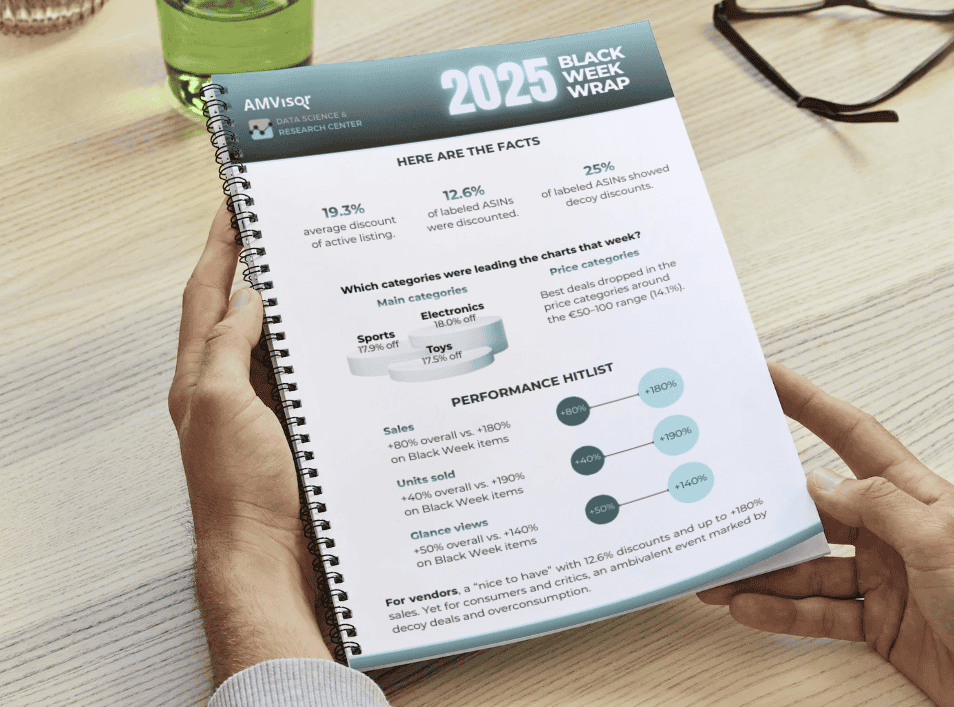
Before the story unfolds, here are the key results:
- Only ~19% of a vendor’s active assortment was discounted during Black Week
- Average real discount: 12.6%
- ~25% of “Black Week deals” weren’t real discounts at all (only vs. MSRP)
- Sales impact
- Total assortment: +80% sales
- Discounted ASINs: +180% sales
- Discount + Ads: +220% sales
- Advertising became cheaper, not more expensive
- ACOS dropped by up to 25% relatively
- TACOS stayed stable
- The most important day was not Cyber Monday
- Day 1, Day 2 — and Black Friday itself dominated sales
Black Week 2025 was not a long sprint.
It was a front-loaded explosion followed by waiting, comparing, and then one last decisive strike on Black Friday.
Where do the numbers come from?
This analysis is not anecdotal. It is not a post-mortem based on a handful of hero SKUs.
The data is based on:
- Tens of thousands ASINs from top brands across Europe and the US
- 13,600 Black Week–labeled ASINs
- 92% of vendors participated with Black Week deals
- Observation period: 20 Nov – 1 Dec 2025, benchmarked against the prior week
Discounts were calculated against the true price low of the previous week, not MSRP — a detail that explains why so many “deals” weren’t deals at all.
Sales, units, glance views, advertising spend, ACOS, TACOS, and halo effects were tracked daily. Think less crystal ball, more seismograph.
Act I: The first two days
If Black Week were a Christmas market, Day 1 and Day 2 would be the moment the gates open.
Sales spiked immediately, before traffic did.
That’s the paradox some vendors missed:
People arrived with intent, not curiosity.
- Sales jumped fast
- Units increased, but less dramatically
- Higher-priced products sold disproportionately well
This was not bargain-bin behavior. This was strategic buying. Shoppers knew what they wanted and many vendors ran out of stock before they fully realized it.
Out-of-stock situations peaked early. Not because vendors planned them — but because they might have underestimated velocity.
Lesson:
Black Week does not warm up. It detonates.
Act II: Comparison, doubt, wishlists
After the initial rush, something counterintuitive happened.
Traffic increased.
Sales slowed.
Glance Views peaked on Day 2 and Day 5, while conversions lagged behind. Customers compared. They waited. They watched prices like hawks on snowy rooftops.
Two quiet phases emerged:
- Sunday–Monday after launch
- Weekend after Black Friday
For vendors, this is where discipline mattered:
- Ads without strategy burned budget
- Discounts without visibility disappeared into noise
Those who stayed present — with controlled bids and stocked hero SKUs — stayed in consideration.
Those who blinked? They vanished.
Act III: Black Friday — the second peak
Then came Black Friday itself.
Sales surged again — especially for higher-priced products.
Interestingly, advertising no longer increased units significantly — but it did increase sales value.
Interpretation:
Shoppers had decided what to buy earlier. Black Friday decided when.
Cyber Monday, once the crown jewel, became an afterthought.
Advertising: A real boost for your listing
Here lies the most misunderstood outcome of Black Week 2025.
Yes, vendors spent more.
- +10.2% more advertised ASINs
- 1.8× daily ad spends vs. normal weeks
But advertising has become more efficient, not less:
- ACOS dropped significantly, especially early and on Black Friday
- TACOS stayed stable, despite aggressive spending
- Ads Sales share increased (≈16.5% → 18.5%)
Why?
Because demand was real.
People were ready to buy — advertising simply ensured who they bought from.
Three practical takeaways for 1P Amazon Vendors in 2026
This is where strategy begins.
1. Don’t discount everything — discount precisely
- Target ~20% of your assortment
Focus on SKUs with:
-
- Strong conversion history
- Review depth
- Strategic relevance for rankings
More discounts do not mean more success.
Precision does.
2. Shift budget forward and aggressively
- Day 1, Day 2, Black Friday are non-negotiable
- ACOS is lowest when competition feels highest
- Saving budget for Cyber Monday is sentimental, not strategic
Buy visibility when intent is hottest — not when it’s cheapest.
3. Treat Black Week as a ranking investment
Stable TACOS means something powerful:
You are buying:
- Market share
- New-to-brand customers
- Reviews
- Algorithmic momentum for December
Black Week is not a margin event.
It is a positioning event.
Conclusion
The Closing Scene: What Remains After the Snow Melts
By mid-December, the banners are gone.
Prices normalize.
Dashboards calm down.
But the effects of Black Week linger.
- In rankings.
- In brand recall.
- In the vendors who planned and those who hoped.
Black Week 2025 told a clear story:
- The event is shorter than it looks
- Advertising is not a cost center, it’s leverage
- Precision beats participation
- And waiting is the most expensive strategy of all
As the year closes and planning for 2026 begins, the question is no longer whether to play Black Week.
The question is whether you’ll enter it prepared or once again watch the snowfall from the sidelines.

Related Posts




Details that matter!
Details that matter!
Receive our exclusive insights, articles, and announcements in your inbox.





